


White Sand Ultra 2027: Frequently Asked Questions
(The ones we’re tired of answering)
1. General Race Info: Why did I sign up for this?
-
What is the White Sand Ultra? It’s a cruel and beautiful journey through the Rann of Kutch. It’s you, against a landscape of salt flats, shifting sands, and the kind of sun that can curdle a camel’s milk. The only thing more vast than the desert is your sense of self-doubt, which we will cultivate with great care.
-
When and where is this happening? The suffering begins at 4 PM on March 27, 2027, and will continue until the last lunatic stumbles across the finish line on March 28, 2027. The starting point is Dholavira, Kutch, Gujarat. If you get lost, just look for the horizon playing tricks on you. That’s a good sign you’re on the right track.
-
What are the race categories? You have four choices, each progressively dumber than the last:
-
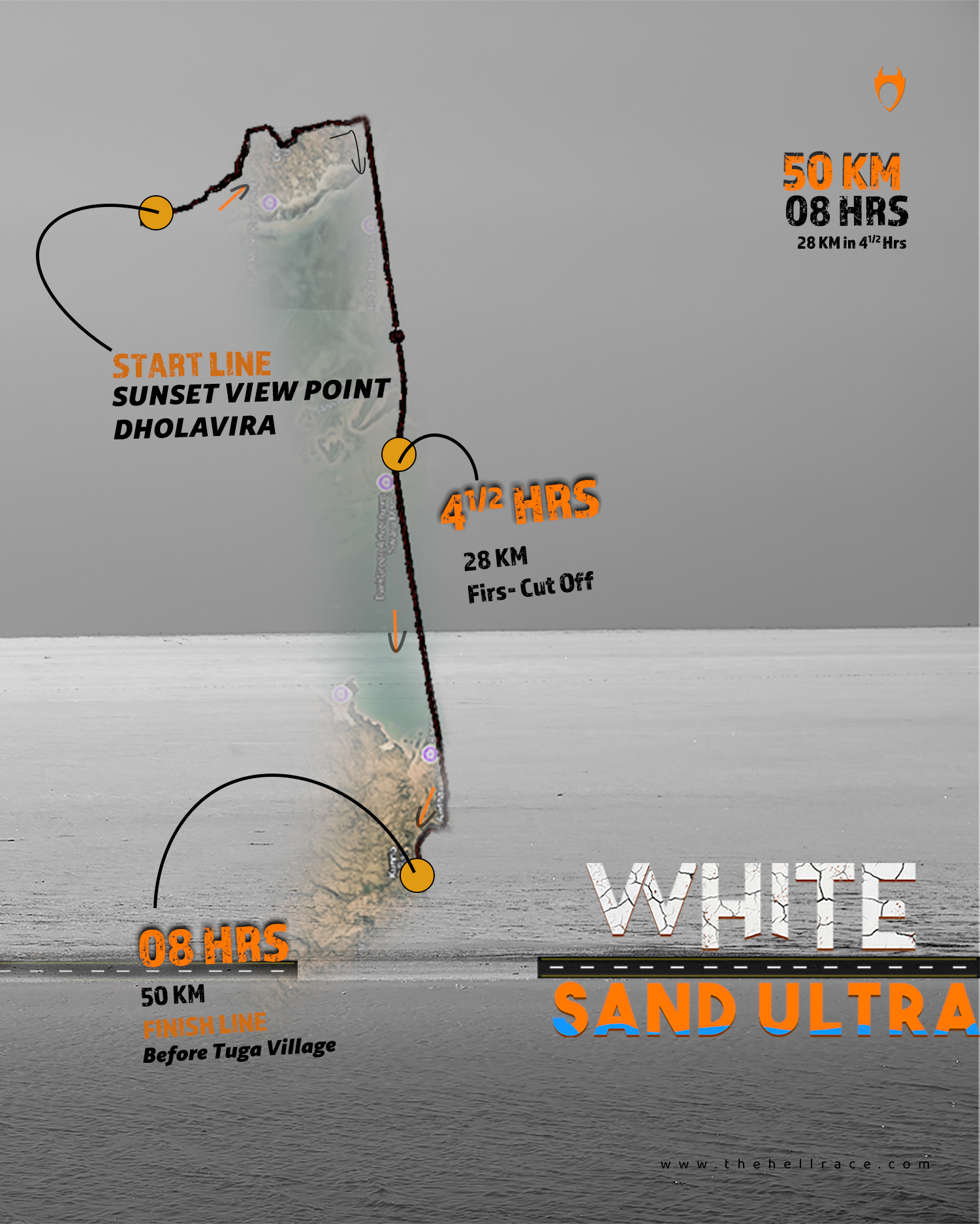
50 KM: The “gateway drug” to desert ultras. Cut-off is a generous 8 hours. We’re giving you just enough time to feel the burn without completely breaking you. Or so you think.
-
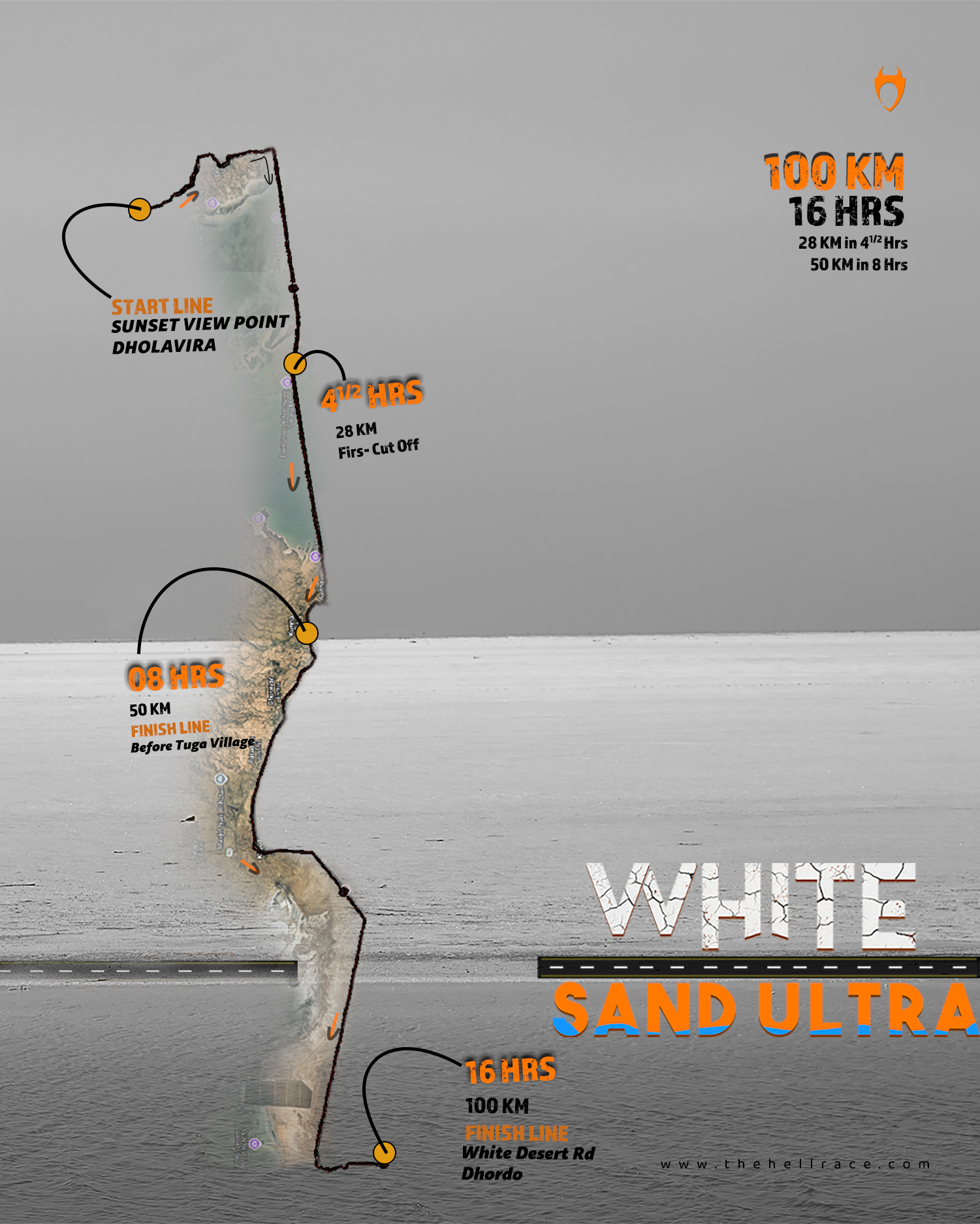
100 KM: The “mid-life crisis.” Cut-off is 16 hours. You’ll move from the scorching daylight to the bone-chilling night. It’s a conversation with your inner strength, and the desert doesn’t whisper; it screams.
-
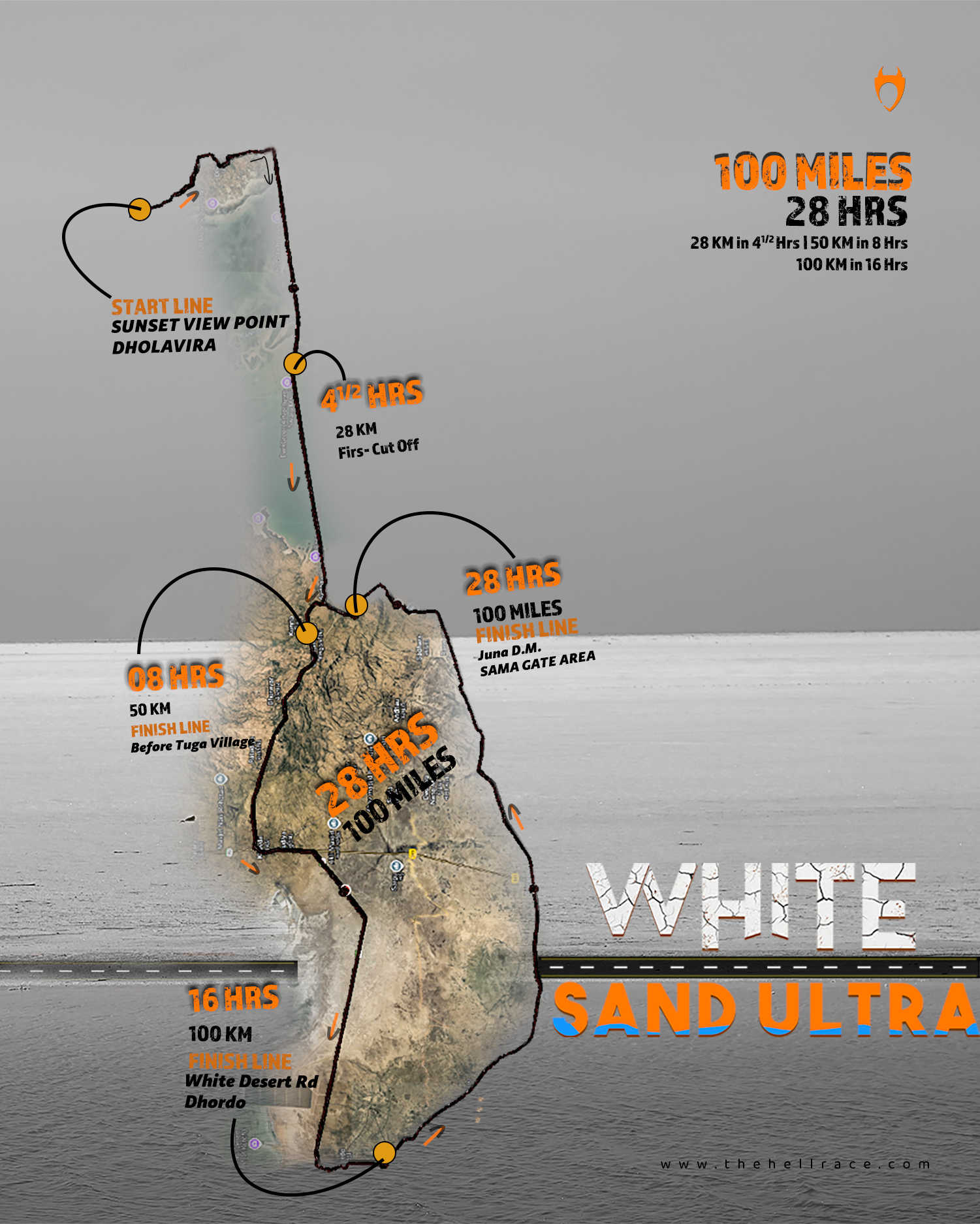
100 Miles (160 KM): The “cruelty badge.” Cut-off is 28 hours. This is where you question every life decision you’ve ever made. The good news? You’ll be so delirious from exhaustion you might hallucinate a finish line.
-
135 Miles (217 KM): The “we-have-a-problem-here.” Cut-off is 38 hours. This is the kind of bad decision your grandchildren will talk about. It’s one of the rare 135-mile ultras in India, because sanity is a hard sell.
-
2. The Logistics of Suffering: How do I suffer less?
-
How far apart are the aid stations? They’re every 7 KM. They’re like mirages, except they’re real. We’ll have water, electrolytes, and the judgmental stares of our volunteers.
-
What about drop bags? You get drop bag access at the 50 KM, 100 KM, and 160 KM points. Label them clearly with your name, bib number, and the point where you want to see them again. Unclaimed bags will be adopted by the desert. No, seriously. Don’t forget your stuff.
-
What should I pack? Your tried-and-tested nutrition, spare socks (trust us on this), shoes, anti-chafe, sunscreen (don’t forget this, unless you want to look like a sun-dried tomato), light layers for the night, a headlamp with extra batteries, and a blister kit. What you should not pack: your ego, glass containers, and live animals (yes, even emotional support cacti).
-
Will there be medical support? Yes, we’ll have medical support on standby. They’re trained professionals who are well-versed in treating dehydration, heat exhaustion, and existential dread.
-
What’s the weather like? During the day, it’s hot enough to slow-cook you. At night, it’s cold enough to give you frostbite. Welcome to Kutch. The desert doesn’t believe in moderation.
3. The Rules: Because in hell, chaos has an order.
-
Can I transfer my bib? No. Your bib is yours. Your pain is yours. Your glory is yours. You can’t gift your bad decisions to someone else.
-
What’s the refund policy? We have a “No Mercy” policy.
-
Cancel more than 30 days out? We’ll refund 100% of your fee. We might ask why, but we’ll still do it.
-
Cancel within 30 days? Tough luck. No refunds. You signed up for suffering, not a spa day.
-
-
What if the race gets cancelled? If there’s a natural disaster, government restriction, or an alien invasion, we’ll let you know what happens next. Don’t expect miracles.
-
Do I have to carry mandatory gear? Yes, and we’re not kidding. Your race bib must be visible at all times. It’s your VIP pass to our aid stations and the finish line. Do not, under any circumstances, litter. We’ll be checking. The desert is pristine, and we’d like to keep it that way. You can carry your garbage to the next aid station.
-
Can I use a pacer? Read the official race regulations carefully. Generally, outside aid is not a thing unless explicitly stated in the pre-race mailer. You’re on your own, sunshine.
4. How to Reach Dholavira: The Road to Oblivion
Getting to Dholavira is an adventure in itself, a perfect prelude to the race. You will learn to appreciate the concept of “remote.”
-
By Air: The closest airport is Bhuj (BHJ). From there, you’ll need to hire a cab. The journey is approximately 220 km and will take about 5-6 hours. This is your last chance to enjoy air-conditioned comfort. Cherish it.
-
By Train: The nearest railway station is also Bhuj. From there, you’ll follow the same car-ride path of self-discovery and impending doom. There are also smaller stations like Bhachau, but unless you’re a local who knows the bus routes, stick to Bhuj.
-
By Road: The roads are in surprisingly good condition, which is a cruel joke, given where they lead. You can drive from Ahmedabad (approximately 7-8 hours) or hire a taxi from Bhuj. The drive itself is a sight to behold, a gradual transition from civilization to a desolate, beautiful landscape.
Travel Hack: Want to be a true local? Take a bus from Bhuj to Rapar and then another one to Dholavira. It’s cheap, it’s a great way to meet the locals who will stare at you like you’re a mirage, and it will give you a real taste of the journey. Just don’t complain about the lack of legroom. You’re training for an ultra, not a business trip.
5. About Dholavira & Stay Options: Your Last Stand Before the Desert Takes You.
-
About Dholavira: Dholavira is not just a starting point; it’s a UNESCO World Heritage site and a testament to the fact that people have been living here for thousands of years. It’s an ancient city of the Indus Valley Civilization, known for its advanced water conservation systems. You can visit the archaeological site, a museum, and see the ancient signboard with the mysterious Harappan script. This is where you can truly appreciate the irony of your situation: running through a place that once had sophisticated urban planning, while your own plan is to run until your legs give out.
-
Dholavira, despite its remote location, has evolved from a simple village with homestays to a place that caters to even the “fancy” runner who needs a proper bed and air conditioning. While the desert itself is a minimalist’s dream, your stay doesn’t have to be.
-
Praveg Resort Dholavira: This is what we call “glamping” in the middle of nowhere. It’s a luxury eco-resort with triangular “A-frame” cottages, some with glass walls for a bit of stargazing—because nothing says “I’m in the middle of a masochistic challenge” like a little luxury.
-
Evoke Dholavira: Another upscale option that blends modern amenities with the serene landscape. It offers well-appointed cottages, a restaurant, and even a swimming pool—perfect for soaking your poor, blistered feet after you’ve decided to punish yourself on the salt flats.
-
Rann Resort Dholavira: A solid choice that provides a comfortable stay with traditional, yet well-maintained, cottages. They focus on local hospitality, which means you might actually get some genuine kindness before you hit the starting line and we strip it all away.
-
Campsites and Homestays: If you’re a true sadist, or just on a budget, there are still plenty of basic homestays and campsites. They offer an authentic experience, with home-cooked meals and a chance to truly feel like you’ve left civilization behind. You can be one with nature—and your own misery.
Remember, whether you choose a luxurious resort or a rustic homestay, the desert will treat you all the same. So book your stay, get a good night’s rest, and prepare for the long, painful, and glorious night ahead. You’ve been warned.
-
-
Weather Conditions: March in Kutch is a special kind of hell. The race starts in the evening, so you’ll get a few hours of merciful sun before it sets. Then, the real fun begins. The temperature plummets at night, becoming surprisingly cold. You’ll be running through salt flats that glow under the moonlight, with a chill that might cut through your bones in the race. Then, as the sun rises again, the temperature will soar, turning the white sand into a griddle. Be prepared for extreme temperature swings. It’s our way of reminding you that the desert is a fickle, unforgiving mistress.
-
The Race Course: The course is an out-and-back route on a mix of terrain. It’s mostly flat, which sounds easy but is a mental torture. You’ll be running on asphalt roads, which are smooth and scarred in parts. The course is well-marked with markers, but don’t wander off. The Rann is vast, and a lost runner is just a cautionary tale for the next batch.
We don’t do this for fun. We do this to ensure you’re a runner, not a slow-moving tourist. If you miss these cut-offs, we will pull you from the race. No exceptions. No begging. No “but my watch says…”
-
50 KM: Must reach 28 KM in 4 hours 30 minutes.
-
100 KM: Must reach 28 KM in 4 hours 30 minutes, and 50 KM in 8 hours.
-
100 Miles (160 KM): Must reach 28 KM in 4 hours 30 minutes, 50 KM in 8 hours, and 100 KM in 16 hours.
-
135 Miles (217 KM): Must reach 28 KM in 4 hours 30 minutes, 50 KM in 8 hours, 100 KM in 16 hours, and 160 KM in 28 hours.
If you manage to drag yourself across the finish line and still have the energy to lift a camera, here are some places you can explore.
-
Dholavira Archaeological Site: The highlight. You’ll have seen it from a distance, but now you can actually walk through the ancient ruins, and contemplate the futility of your existence while standing in a place thousands of years old.
-
The White Desert: At dawn and dusk, the salt flats are a photographer’s dream. The way the light plays on the white surface is surreal. Go get your Instagram-worthy photos. You’ve earned the right to brag.
-
Dholavira Museum: See the artifacts from the excavation. It’s a great place to learn about the history of the civilization you just ran through.
-
Flamingo Watching: The wetlands near Dholavira are a migratory hotspot for flamingos and other birds. If you’re lucky, you’ll see them fly against the backdrop of the sunrise. A truly majestic sight that will make you feel a little better about your blisters.